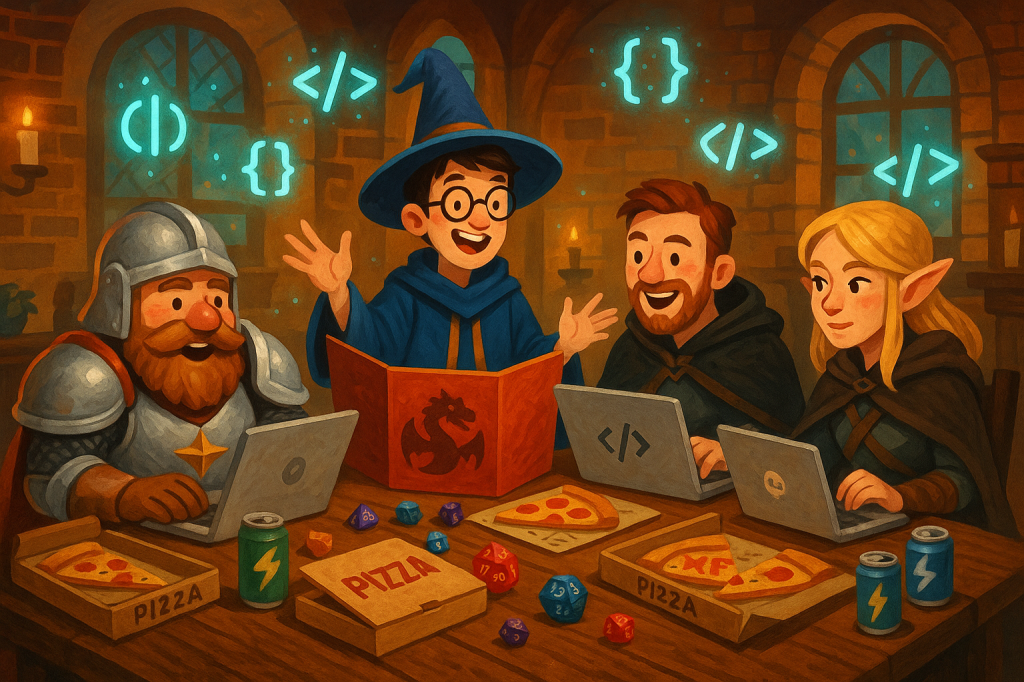
In an era where “synergy” and “collaboration tools” have been cast so often they might as well have cooldown timers, one might wonder — what could possibly resurrect true teamwork among software developers?
The answer doesn’t come from another productivity suite or stand-up meeting. It comes from rolling dice, defeating goblins, and failing spectacularly at persuasion checks.
Yes, brave adventurer, the secret spell for world-class software team-building is Dungeons & Dragons (D&D) — a tabletop role-playing game that transforms your team from code-slinging mortals into fellowship-forging heroes.
The Developer’s Natural Habitat: The Table of Infinite Imagination
Picture it: your lead backend developer is now a stoic dwarven paladin. The QA engineer? A mischievous wizard armed with Fireball and a healthy disregard for Jenkins downtime.
In the realm of D&D, hierarchies crumble faster than a brittle stack overflow. The quietest dev in the room suddenly becomes the party’s silver-tongued negotiator. The project manager might be a bard — both inspirational and occasionally surrounded by mysterious magical chaos.
The result? Developers rediscover what it means to communicate, adapt, and improvise — skills as crucial in slaying dragons as in squashing bugs.
Debugging Dragons: Parallels Between Coding and Campaigns
Let’s be honest. Software development is already a kind of D&D campaign:
- There’s a mysterious client request written in riddle form.
- A party of devs embarks on a sprint quest with low mana (read: coffee).
- The final boss? A deployment at 4:59 pm on a Friday.
But in D&D, every problem is approached through creative collaboration. You can’t brute-force a dragon with if-statements — you debate, experiment, and think sideways.
That’s exactly what great engineering teams do when faced with complex systems. They blend logic, imagination, and the occasional natural 20.
Why It Works: Fellowship, Fails, and Fun
- Shared Stories Build Shared Trust: When you’ve watched your UX designer heroically fail a stealth check while trying to sneak past goblins, there’s a bond forged that no corporate icebreaker can replicate.
- Safe Space for Failing Forward: In D&D, bad rolls lead to great stories. In development, failed tests lead to innovation. Both demand psychological safety — and both reward resilience.
- Creative Problem-Solving Under Chaos: Whether navigating fantasy politics or debugging race conditions, the ability to stay calm and collaborate amidst madness is an art. D&D gives teams a magical crash course.
- Fun Beats Forced Interaction: No team ever said, “Wow, that trust fall changed my life.” But they have said, “Remember when we polymorphed the boss into a sheep and escaped on flying mugs of ale?”
From Campaign to Codebase
After weeks of shared quests, something magnificent happens. Your dev team starts talking differently — more openly, more imaginatively, more… humanly.
Daily stand-ups become more like war councils. Design discussions turn into creative brainstorms. The dreaded “Difficult Conversation About Technical Debt” becomes a “Dragon We Shall All Slay.”
In short, D&D doesn’t just bond your team — it levels them up.
The Call to Adventure
So next time your team needs a morale boost, skip the bowling alley or the awkward offsite scavenger hunt. Instead, light some candles, roll some dice, and unleash your collective imagination.
Because whether in code or campaign, true greatness emerges from collaboration, courage, and critical hits.
And remember, adventurers: when the next merge conflict arises, just ask yourself — what would your party do?
Tagline:
🧙♂️ Dungeons & Dragons — where every meeting becomes a quest, every teammate a hero, and every bug fix a triumph worth singing about.